

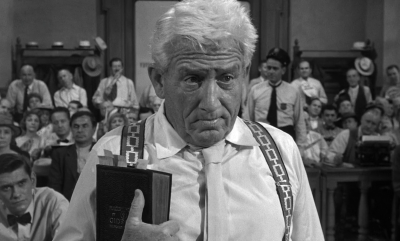
The Bible is the news today. Perhaps not since the Scopes trial has it received this much public attention. (The centennial of that trial of the century will be the subject of a future blog.) But what do the Mean AGainst Americans mean when they refer to the Bible? And what do they mean about their knowledge of the Bible?
DONALD TRUMP AND THE BIBLE
Donald Trump can’t read a book so it should be no surprise that he has not read the Bible. So what does it mean when he refers to the Bible?
Donald Trump regularly tells crowds that his memoir is only his second favorite book.
His first? The Bible.
“As much as I love ‘The Art of the Deal,’ it’s not even close,” he said Friday. “We take the Bible all the way.”
But when asked Wednesday on Bloomberg’s “With All Due Respect” to share his favorite verses, Trump, a Presbyterian, was not as direct.
“I wouldn’t want to get into it. Because to me, that’s very personal,” he said. “The Bible means a lot to me, but I don’t want to get into specifics.”
Trump, who once referred to communion as “my little wine and my little cracker,” was asked if he prefers the New or Old Testaments.
“Probably equal. I think it’s just incredible,” he said.
(“Trump says Bible is his favorite book, but declines to share favorite verse” Eugene Scott, CNN, August 27, 2015)
The following year he could identify his favorite biblical verse.
The Bible verse that really resonates with Donald Trump is “an eye for an eye,” from the Old Testament.
In a radio interview on WHAM 1180AM, host Bob Lonsberry asked the GOP presidential front-runner if there is a favorite Bible verse or story that has informed his thinking or his character throughout his life.
“Well, I think many. I mean, when we get into the Bible, I think many, so many. And some people, look, an eye for an eye, you can almost say that,” Trump said. “That’s not a particularly nice thing. But you know, if you look at what’s happening to our country, I mean, when you see what’s going on with our country, how people are taking advantage of us, and how they scoff at us and laugh at us. And they laugh at our face, and they’re taking our jobs, they’re taking our money, they’re taking the health of our country. And we have to be very firm and have to be very strong. And we can learn a lot from the Bible, that I can tell you.” (“Donald Trump names his favorite Bible verse” Rebecca Shabad, April 14, 2016 / 2:16 PM EDT / CBS News).
Here is the biblical verse that Trump apparently is referring to:
Exodus 21:22 “When men strive together, and hurt a woman with child, so that there is a miscarriage, and yet no harm follows, the one who hurt her shall be fined, according as the woman’s husband shall lay upon him; and he shall pay as the judges determine. 23 If any harm follows, then you shall give life for life, 24 eye for eye, tooth for tooth, hand for hand, foot for foot,
Without engaging in biblical exegesis of this verse, one response seems readily clear. The verse in not a general legal precept. It applies to a specific situation involving a pregnant woman who is harmed.
The verse illustrates the difference between the Bible in popular culture and the Bible itself. The phrase has been removed from its particular context and has been generalized. That is the verse Trump knows.
Consider this more famous example.
Genesis 3:2 And the woman said to the serpent, “We may eat of the fruit of the trees of the garden; 3 but God said, `You shall not eat of the fruit of the tree which is in the midst of the garden, neither shall you touch it, lest you die.'” 4 But the serpent said to the woman, “You will not die. 5 For God knows that when you eat of it your eyes will be opened, and you will be like God, knowing good and evil.” 6 So when the woman saw that the tree was good for food, and that it was a delight to the eyes, and that the tree was to be desired to make one wise, she took of its fruit and ate; and she also gave some to her husband, and he ate.
Most people would say Adam and Eve at an apple. But the biblical passages say “fruit” and not “apple.” This makes more sense. Apple orchards were rare at best in the ancient Near East; date orchards were the fruit most familiar to the original audience. The likelihood is that the original audience would have interpreted the story to mean apple. The Bible and popular culture about what is in the Bible are not one and the same.
Trump’s knowledge of the Bible is suspect.
Speaking to students at Liberty University in January, Trump attempted to show his knowledge of the Bible with multiple religious references. But he bungled one.
“Two Corinthians, right? 3:17, that’s the whole ballgame,” Trump said. “Where the spirit of the Lord, right…there is liberty. Here, there is liberty…Liberty University, but it is so true. You know when I think, and that’s really – is that the one? Is that the one you like?”
The correct reference is “Second Corinthians,” which refers to the second letter of Paul to the Corinthians.
(“Donald Trump names his favorite Bible verse” Rebecca Shabad, April 14, 2016 / 2:16 PM EDT / CBS News).Rebecca Shabad is a video reporter for CBS News Digital https://www.cbsnews.com/news/donald-trump-names-his-favorite-bible-verse/© 2016).
Of course there is the famous example of when Trump held the Bible upside down in Lafayette Park. The Bible was a prop and not a book with which he is familiar.
SECRETARY OF DEFENSE PETE HEGSETH
A memorable exchange occurred between Democratic senator Elissa Slotkin and the worst Secretary of Defense in American history. The issue was whether troops deployed to southern California were allowed to arrest protesters or shoot them in the legs.
Hegseth laughed in response to the question and said: “Senator, I’d be careful what you read in books and believing in, except for the Bible.”
The stunned Senator replied at the absurdity of the response with: “Oh my God.”
Here was a missed opportunity. The Senator might have inquired which Bible – the Jewish Bible, the longer Protestant Bible, the even longer Catholic Bible, or finally the even longer Eastern Orthodox Bible Hegseth meant. Remember the battles between Protestants and Catholics in Philadelphia in the 1840s over which Bible should be used in the classroom.
What would the Secretary says about this verse
Isaiah 45:1 Thus says Yahweh [often translated as the LORD] to his messiah [generally translated as “anointed”], to Cyrus, whose right hand I have grasped, to subdue nations before him and ungird the loins of kings, to open doors before him that gates may not be closed.
When people think of “messiah”, they generally think of a descendant of David. They overlook that even non-Davidic descendants can be the anointed one. David refers to Saul as Yahweh’s anointed. Cyrus is a savior because he permitted the Jews in Exile in Babylon to return home. It would be interesting to hear what Hegseth thinks about the Persian Cyrus as an anointed one, a savior. How would that affect his attitude towards the Persian people today?
THE WORLD VIEW OF MICHAEL JOHNSON
Johnson: “Go pick up a Bible off your shelf and read it. That’s my world view.”
Please elaborate. Remember Israel and Judah engaged in international diplomacy and wars with multiple countries such as Egypt, Assyria, Babylonia, and Persia. There were pros and cons about defying them, submitting to them, seeking allies against them, and the folly of seeking allies against them. Please elaborate what you mean by your world view in the real world of geopolitics today.