

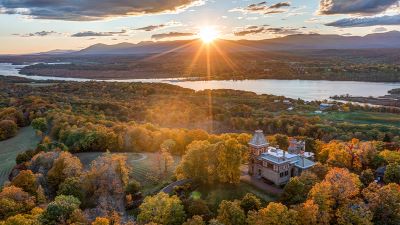
Normally, Hudson River Art and Trump’s Arch are not linked together. The Hudson River artists painted the sublime and the beautiful, as if the scene was part of God’s Eden. By contrast the arch is a monstrosity dedicated to the vanity of one person. The artists sought to record the view of what they saw; the President is seeking to disrupt the existing view linking hallowed sites of our history with his alien arch. In both cases the view is involved.
What is the value of a view? On October 26, 2023, Michael Kimmelman asked “Regulate the Skyline? What’s Your View? (NYT). Note the play on words in asking for view/opinion and asking for your view/what can you see. The subtitle is “It’s not a new question, but it seems more important than it ever has before.”
The article was mainly about Manhattan. Views of the Empire State Building figured prominently. Not only is the famed building iconic, it also is physically isolated from any nearby rivals. Part of this is due to the bedrock which provides for a sturdy foundation in lower Manhattan and mid-Manhattan but less so in between. One result is that the Empire State Building provides a double view:
1. it provides a 360-degree view from the Observation Deck unencumbered by any intrusions
2. it provides a ground –level orientation point for people not sure where they are when getting out of the subway.
That view was jeopardized by what the author characterized as “yet another anorexic supertall for squillionaires.” It will be an 860-foot tall building with 26 apartments.
This article triggered something in my mind. It reminded me of view stories in the Hudson Valley. One of the oldest if not the oldest view stories literally is that from James Fenimore Cooper in The Pioneers.
“There’s a place in them hills that I used to climb to, when I wanted to see the carryings on of the world, that would well pay any man for a barked shin or a torn moccasin. You know the Catskills, lad, for you must have seen them on your left, as you followed the river up from York, looking as blue as a piece of clear sky, and holding up the clouds on their tops, as the smoke curls over the head of an Indian chief at the council fire. Well, there’s the High-peak and Round-top, which lay back, like a father and mother among their children, seeing they are high above all the other hills. But the place I mean is next to the river, where one of the ridges juts out a little from the rest, and where the rocks fall for the best part of a thousand feet, so much up and down, that a man standing on their edges is fool enough to think he can jump from top to bottom.”
“What see you when you get there?” asked Edwards.
“Creation!” said Natty, dropping the end of his rod into the water, and sweeping one hand around him in a circle — “all creation, lad…”
So at the same time as the birth of Hudson River School by Thomas Cole, Cooper was describing a view of what was being painted. To see the creation as sun rise was grand sight indeed. In 1825, Cole painted a “View of Fort Putnam (West Point). True it was not a view in nature, but the operative word here is “view.”
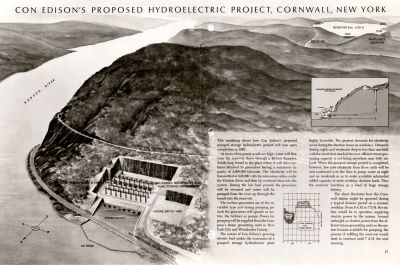
The first example of a threat to the Hudson River view was from the proposed Storm King project by Con Ed. In 1962, Consolidated Edison applied to the Federal Power Commission for a license to construct a hydroelectric storage plant in the Hudson Highlands. The drawing of the proposed plant cutting into the highlands became memorable in its own right. Just as the demolition of Penn Station spurred an historic preservation movement in New York, so to the proposed hydroelectric plant spurred an effort to preserve the scenic Hudson view and the creation of the organization Scenic Hudson.
A rather lengthy legal battle ensued which I will not recount here. What is relevant is that there is more to a construction proposal than cost. More than even the environment. There is something intangible: the view. That view belongs to people who do not own the land but whose right to enjoy the view of it needs to be taken into account.
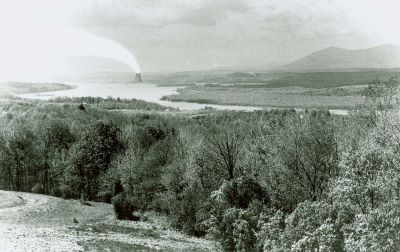
Years later another power plant threatened the view. This time it was a nuclear plant. And with no sense of irony, it was to be built in view of the home of Hudson River Art painter Frederic Church. His Olana homestead was on the opposite side of the Hudson River from the proposed nuclear power plant. This time, Harvey Flad, Vassar College, who has presented in IHARE Teacherhostels/Historyhostels testified on behalf of the view. He made me aware of the issue. He and others took “visual preference surveys” to determine the preference of those people who would view the construction. The “no nuclear plant view” prevailed. It changed the legal landscape as well.
According to the judgment:
Hudson relies on the area’s high quality of life, contributed to by the visual appeal of the area, its historic fabric and texture, its pastoral setting, and attractions such as its waterfront park and Olana as the basis for continued economic growth.
Thus a legally-binding decision on the value of the view was rendered.
The same considerations apply to Trump’s arch. It will not standalone but will be part of the architectural fabric of the community. It would stand on the west bank of the Potomac River on Memorial Circle across from the Lincoln Memorial. The 1901 McMillan Plan expanded the capital’s basic grid and concept to transform the National Mall into a unified landscape. It reinforced the axial relationship that connects the U.S. Capitol, the White House, the Lincoln Memorial and the Arlington National Cemetery. Now Trump would violate and assault that unity by making himself the center of the capital and the country.
Furthermore, not only has Trump rigged the vote on all the relevant councils which need to approve the monstrosity dedicated to himself. Now he is seeking to change the rules governing Section 106 under the Advisory Council on Historic Preservation. According to Sara Bronin, law professor at the George Washington Law School who previously chaired the Advisory Council on Historic Preservation:
1. the changes would narrow the types of historic properties protected
2. weaken consultation with tribal nations
3. dramatically curtail public participation
4. exempt large categories of federally backed state and local projects from Section 106.
She anticipates a successful legal challenge. Even the assessments by the NPS acknowledge that the arch would adversely affect the landscape by altering the character-defining views, settings and spatial relationships. Already Vietnam War veterans have sued to stop the project. Who would have though a failed nuclear power plant decades ago on the Hudson River would provide another weapon in the quest to save the view in the nation’s capital.
This blog is indebted to “Inside Trump’s Rush Job to Build His Arch,” by Janay Kingberry (July 19, 2026, The Atlantic).